How Much Does It Cost to Replace an Electrical Panel?
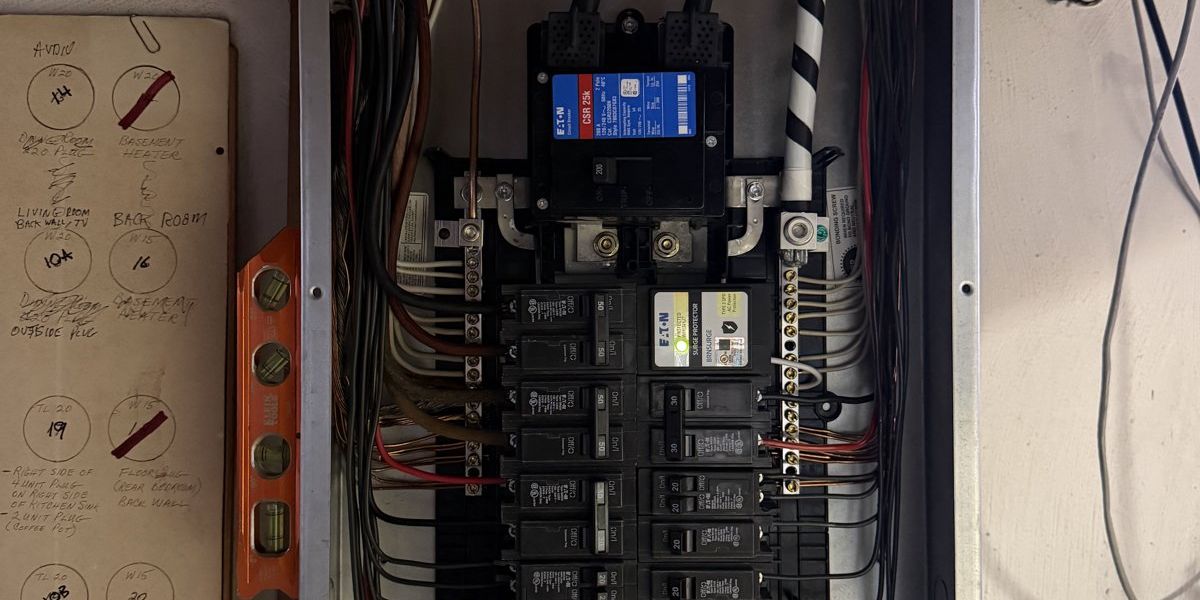
Replacing an electrical panel costs $900 to $2,200 for most homes, averaging around $1,500. A 100-amp to 200-amp upgrade — the most common job — runs $1,300 to $3,000, and a full 200-amp to 400-amp service upgrade runs $4,000 to $9,700 or more. Angi's 2026 data puts the average panel upgrade at $1,600, with most homeowners paying $1,200 to $2,000.
"Replace the panel" can mean three different jobs at three different prices: a like-for-like swap of a failed panel, a 100-amp to 200-amp upgrade (the one most people need), or a full service upgrade with new meter base and wiring. Quotes that do not say which job they price are not comparable.
Electrical Panel Replacement Cost at a Glance
The table below shows typical prices in the United States, checked Nov 10, 2026 (sources: Angi, This Old House, and HomeGuide).
| Item | Typical cost |
|---|---|
| Average panel upgrade | About $1,600 |
| Most upgrades | $1,200–$2,000 |
| Like-for-like panel swap | $850–$2,200 |
| 100→200 amp upgrade | $1,300–$3,000 |
| 200→400 amp service upgrade | $4,000–$9,700+ |
| 200-amp panel, unit only | $250–$350 |
| Labour share of the total | 50–70% |
| Permit | $50–$500 |
This Old House's March 2026 pricing puts most 200-amp upgrades at $1,300 to $3,000. The $1,500 average for a standard replacement and the $2,200 average for a 100-to-200-amp upgrade are the two numbers to remember.
Three Different Jobs, Three Price Bands
The confusion in this market is that all three jobs get called "panel replacement." They are not the same work.
A like-for-like swap replaces a failed 200-amp panel with a new 200-amp panel in the same place, with no service-entrance work. It takes 4 to 8 hours: new panel, new main breaker, breakers moved over, grounding updated, permit, and inspection. It costs $850 to $1,850 for the simplest version, or $900 to $2,200 once the permit and a few extras are in.
A 100-amp to 200-amp upgrade replaces the panel and increases the home's capacity. It takes 1 to 3 days and costs $1,300 to $3,000 for a standard project. The extra work is the meter base, the service entrance conductors, and the grounding system — and often utility coordination, because the power must be disconnected and reconnected.
A 200-amp to 400-amp service upgrade is a different scale again: two 200-amp panels or one 400-amp panel, larger conduit and wire, and often a transformer or service drop upgrade by the utility. It costs $4,000 to $9,700 or more, and it is typical for large homes adding solar, two electric vehicles, a heat pump, and a battery at the same time.
| Job | What changes | Typical cost | Time |
|---|---|---|---|
| Like-for-like swap | Panel only | $850–$2,200 | 4–8 hours |
| 100→200 amp upgrade | Panel + meter base + service wiring | $1,300–$3,000 | 1–3 days |
| 200→400 amp upgrade | Panels + service + often utility work | $4,000–$9,700+ | 1–3 days |
Cost by Amperage
Amperage is the biggest price lever after labour. Most homes doing an upgrade today target 200 amps, because it leaves room for an EV charger, a heat pump, and a future addition without a second project in five years.
| Service size | Panel only | Panel + install |
|---|---|---|
| 100 amp | $150–$250 | $800–$1,500 |
| 150 amp | $200–$300 | $1,000–$1,800 |
| 200 amp | $250–$350 | $1,300–$2,000 |
| 400 amp | $500–$1,000 | $4,000–$9,700+ |
The panel itself is the cheapest part — $250 to $350 for a 200-amp unit. Labour is 50 to 70 percent of the total, which is why two quotes for the same panel can differ by $1,000. A new 200-amp panel alone does not create 200-amp service — if the meter and conductors still support only 100 amps, the upgrade is not finished.
What the Panel Price Does Not Include
The panel quote is the visible half of the job. The rest is the service entrance — the parts between the street and the panel — and it is where budgets break.
A meter base upgrade runs $200 to $500, new service entrance conductors $300 to $1,000 depending on length, a mast or weatherhead $200 to $600, and drywall repair $200 to $500. And the permit, which every jurisdiction in the US requires for panel work, runs $50 to $500 depending on the city.
Utility coordination is the hidden time cost: the power company must disconnect the service before the work and reconnect it after inspection, usually a scheduled outage of 4 to 8 hours. A quote that does not mention the utility has not finished planning the job.
When You Actually Need an Upgrade
Not every old panel needs replacing. Here are the signs that do mean it.
Tripping breakers are the most common: if the main breaker trips when the air conditioner and the dryer run together, the service is undersized for the load. Flickering lights when a large appliance starts are the same signal. A panel that is hot to the touch, or breakers that will not stay on, are safety issues — call an electrician now, not next month.
New loads are the second trigger: an EV charger needs a dedicated 40- or 50-amp circuit, a heat pump 30 to 60 amps, and a whole-home electric tankless up to 120 amps. Add any two to a 100-amp service and the upgrade is not optional.
Federal Pacific Stab-Lok and Zinsco panels, both common before 1990, have documented breaker failure rates — they can fail to trip when they should. Many insurers now refuse to cover homes with them.
The NEC 80% rule is the maths behind all of this: a 200-amp panel yields only 160 amps of usable continuous capacity, and a 100-amp panel only 80 amps. If your continuous loads add up to more than 80% of the rating, the panel is undersized even if nothing has tripped yet.
The 25C Credit Is Gone — Check HEAR Rebates Instead
The same freshness trap as our heat pump and tankless guides applies here. The federal 25C energy-efficient home improvement credit, which covered up to $600 for a qualifying panel upgrade, expired on December 31, 2025, under the One Big Beautiful Bill Act. It is not available for work done in 2026.
What replaced it is the HEAR program — Home Electrification and Appliance Rebates — which offers up to about $4,000 for a panel upgrade plus about $2,500 for associated wiring, for income-qualified households. HEAR is administered state by state, so availability and amounts vary, and the money is limited. Check your state energy office before budgeting, and do not count on it until the rebate is confirmed in writing.
A Worked Example: 100→200 Amp Upgrade
Take a homeowner in a 1960s home with a 100-amp panel, adding an EV charger and a heat pump, upgrading to 200 amps.
| Line item | Cost |
|---|---|
| 200-amp panel and breakers | $300 |
| Additional breakers and parts | $200 |
| Labour, master electrician, 1.5 days | $900 |
| Permit and inspection | $250 |
| Meter base upgrade | $300 |
| Total | $1,950 |
That lands inside the $1,300 to $3,000 band for a standard 100-to-200-amp upgrade, near the middle. If the utility also had to upgrade the service entrance wiring, add $1,000 to $2,000.
Mistakes to Avoid
- Comparing a swap quote to an upgrade quote. A like-for-like swap and a 100-to-200-amp upgrade are different jobs. Make sure every quote prices the same job.
- Counting on the 25C credit. It expired December 31, 2025. A quote that subtracts it is using last year's rules.
- Forgetting the meter base and service wiring. A 200-amp panel on a 100-amp service is not a 200-amp upgrade.
- Hiring unlicensed help. Panel work needs a master electrician and a permit in every jurisdiction. Unlicensed work can void your home insurance.
- Waiting on a Federal Pacific or Zinsco panel. If your insurer will not cover it, or the breakers are failing to trip, replacement is a safety job, not a renovation.
Frequently Asked Questions
How much does it cost to replace an electrical panel?
About $1,500 on average, checked Nov 10, 2026, with most replacements between $900 and $2,200. A 100-amp to 200-amp upgrade runs $1,300 to $3,000.
Do I need a permit to replace an electrical panel?
Yes. Every jurisdiction in the US requires a permit for panel work, at $50 to $500, plus an inspection. A contractor who offers to skip the permit is one to skip.
How long does an electrical panel replacement take?
Four to eight hours for a like-for-like swap. One to three days for a 100-to-200-amp upgrade, because of the meter base, service wiring, and utility coordination.
Is the federal tax credit still available for panel upgrades?
No. The 25C credit expired on December 31, 2025. The HEAR rebate program offers up to about $4,000 for income-qualified households, administered state by state.
When should I upgrade from 100 amps to 200 amps?
When you add an EV charger, a heat pump, or a tankless water heater; when breakers trip under normal loads; or when you have a Federal Pacific or Zinsco panel. A 200-amp service leaves room for future additions without a second project.