How Much Does Radon Mitigation Cost?
Radon mitigation costs $800 to $2,500 installed for most homes, averaging about $1,500. Angi's 2026 data from 1,184 verified projects puts the average lower, at $1,043, with most homeowners paying $805 to $1,326 — while HomeGuide's range runs $1,200 to $2,000 with an average of $1,600. The spread is the foundation: a standard basement job is the cheap end, and a crawl space with a sealed membrane is the expensive end.
Radon is a colourless, odourless gas that seeps up from the soil, and it is the second-leading cause of lung cancer in the United States — the EPA estimates it causes about 21,000 lung cancer deaths a year, and roughly 1 in every 15 American homes has an elevated level. The fix is comparatively cheap for the risk it removes, and it starts with a test, not a contractor.
Radon Mitigation Cost at a Glance
The table below shows typical prices in the United States, checked Nov 11, 2026 (sources: Angi, HomeGuide, HomeAdvisor, and the EPA).
| Item | Typical cost |
|---|---|
| National average | About $1,500 |
| Most systems | $800–$2,500 |
| Angi average (1,184 projects) | $1,043 |
| HomeAdvisor average | $1,028 |
| DIY test kit | $15–$35 |
| Professional test | $150–$250 |
| Fan running cost | $70–$100 per year |
| Permit | $25–$150 |
HomeAdvisor's data puts the average at $1,028, with most homeowners spending $786 to $1,274; small homes can run as little as $395 and large or complex jobs up to about $2,453. The $800 to $2,500 band is the one every source agrees on — it is also the band the EPA itself has quoted for years, which is worth knowing, because that figure is older than it looks (see the trap below).
Test First: The $15 Step Before the $1,500 Step
Only a test of your specific home tells you its radon level. Your neighbour's result tells you nothing — radon varies with the geology under each house, and two homes on the same street can test very differently.
A DIY short-term test kit costs $15 to $35 including the lab fee: you leave the charcoal canister in the lowest lived-in level for two to seven days, then mail it in. A professional test costs $150 to $250, and HomeGuide puts the range at $125 to $400 — the pro brings a continuous monitor that reads hour by hour, which matters because radon levels rise and fall with the weather and the season.
The EPA's action level is 4.0 picocuries per litre (pCi/L) of air. At or above that reading, the EPA recommends installing a mitigation system. Below 4.0, the EPA still recommends considering a fix between 2.0 and 4.0 — there is no level the EPA calls safe, only a level where action becomes urgent. Test in winter if you can: homes are sealed tight then, and readings run highest.
Cost by Foundation Type
The foundation decides the system, and the system decides the price. A basement with a concrete slab is the standard job; a crawl space is the expensive one.
| Foundation / situation | Typical installed cost | Notes |
|---|---|---|
| Basement, sub-slab suction | $800–$1,800 | The standard job; one suction point |
| Slab-on-grade | $800–$1,500 | Similar to basement, no basement walls |
| Crawl space (membrane + suction) | $1,500–$4,000 | Sealed membrane first, then suction |
| Radon in water (well water) | $3,000–$5,000+ | Aeration or carbon; separate system |
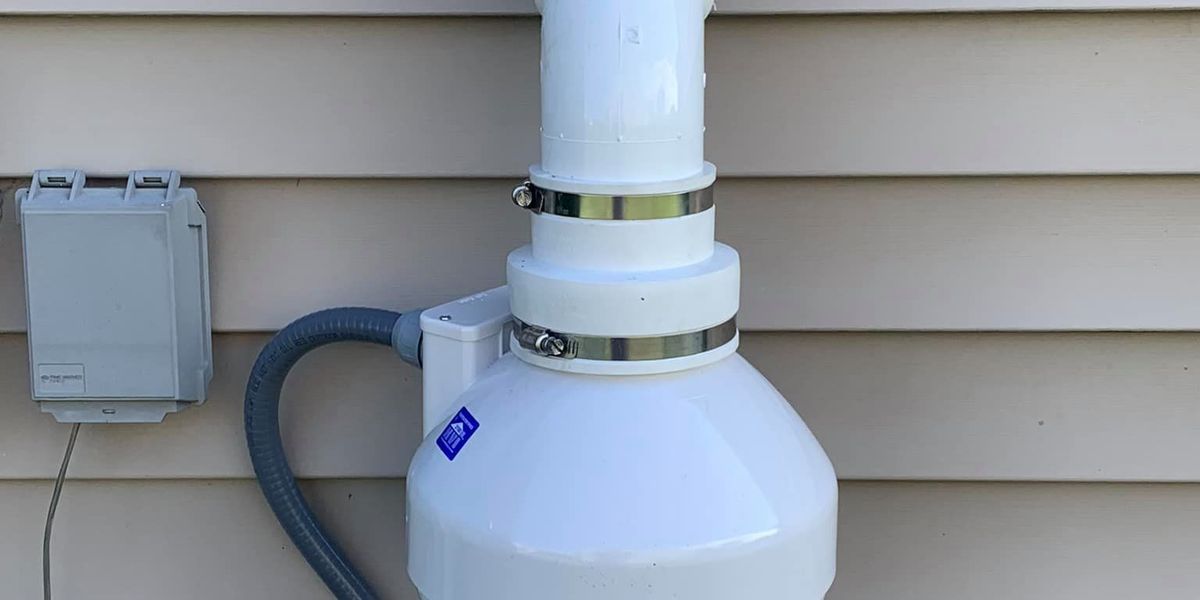
The standard fix is active soil depressurization: a fan draws soil gas from beneath the foundation through a PVC pipe and vents it above the roofline, typically cutting indoor levels by 90 percent or more. One suction point handles most homes. A crawl space costs more because a sealed plastic membrane has to go down over the soil before anything can be drawn from beneath it — the membrane alone is a day of work.
Radon in water is a different problem with a different system and a different quote. If your home is on well water, test the water separately: aeration or carbon treatment runs $3,000 to $5,000 or more, on top of any air system.
Cost by System Type
Within a foundation, the method sets the price. Active systems cost more than passive ones, and the fan is what makes the difference.
| System | Typical cost | Best for |
|---|---|---|
| Passive depressurization (no fan) | $500–$2,500 | New builds, low readings |
| Active sub-slab suction (fan-powered) | $800–$1,300 | Most homes — the standard fix |
| Active suction, large or complex home | $1,000–$3,000 | Multiple suction points |
| Block wall suction | $1,200–$2,000 | Hollow-block basement walls |
A passive system is just pipe — it relies on the stack effect to draw gas up, and it works best in a new build where the pipe can be routed during construction. An active system adds a fan, and the fan is the part that guarantees the reduction: Angi's 2026 data puts active suction soil depressurization at $805 to $1,326 for the system installation. The fan runs continuously and costs roughly $70 to $100 a year in electricity, and it lasts about 10 to 15 years before it needs replacing.
The Price Trap: The EPA's $800–$2,500 Figure Is From 2006
Here is the detail almost every price guide skips: the $800 to $2,500 range that appears on every radon page traces back to the EPA's December 2006 guide, "A Consumer's Guide to Radon Reduction." It is still quoted everywhere, and 2026 contractor data happens to land in the same band — Angi, HomeGuide, and HomeAdvisor all cluster inside it — but the figure itself is twenty years old. Treat it as a planning range, not a current price survey, and get an itemised local quote before budgeting.
The same caution applies to the running costs. One radon company's site recently removed its own fan-cost figures after admitting they had no source. The $70 to $100 a year in electricity above is the figure contractor guides converge on for a standard fan — ask your installer for the fan's wattage and do the maths for your electricity rate rather than trusting a round number.
A Worked Example: Basement Home at 6.2 pCi/L
Take a homeowner whose test comes back at 6.2 pCi/L — above the EPA's 4.0 action level — in a single-family home with a basement.
| Line item | Cost |
|---|---|
| Professional test (already done) | $200 |
| Active sub-slab system, one suction point | $1,100 |
| Permit | $75 |
| Post-install verification test | $150 |
| Total | $1,525 |
That lands at the $1,500 national average. The verification test is the step people skip: a post-install test proves the system worked, and a contractor who offers a written performance guarantee should include it. If the retest still reads above 4.0, the fix is a second suction point, not a second system.
Mistakes to Avoid
- Mitigating before testing. A test costs $15 to $35. A system costs $1,500. Test first — and test the lowest lived-in level, not the attic.
- Trusting a neighbour's result. Radon varies house by house. Only your home's test counts.
- Hiring without certification. Hire an NRPP- or NRSB-certified mitigator, and demand an itemised quote with a written performance guarantee plus post-install verification testing.
- Skipping the verification test. A system without a retest is an assumption, not a fix. Budget $150 for it.
- Forgetting radon in water. If you are on well water, test the water too — air mitigation does nothing for it, and the water system is a separate $3,000 to $5,000.
Frequently Asked Questions
How much does radon mitigation cost?
About $1,500 on average, checked Nov 11, 2026, with most systems between $800 and $2,500 installed. Angi's 2026 data from 1,184 projects puts the average at $1,043, and HomeAdvisor's at $1,028.
What radon level requires mitigation?
The EPA recommends fixing the home at or above 4.0 pCi/L. Between 2.0 and 4.0, the EPA recommends considering a fix. There is no level the EPA calls safe.
How much does radon testing cost?
A DIY kit costs $15 to $35 including the lab fee. A professional test with a continuous monitor costs $150 to $250. Test the lowest lived-in level, ideally in winter when readings run highest.
How long does a radon mitigation system last?
The system itself lasts decades; the fan lasts about 10 to 15 years and costs roughly $70 to $100 a year in electricity to run. Budget for a fan replacement in the second decade.
Does homeowners insurance cover radon mitigation?
No. Radon mitigation is a maintenance and health measure, not a covered loss. The test, the system, and the fan are all out of pocket — which is why the $15 test comes first.