50/30/20 Budget Rule Explained: A Simple Way to Split Your Paycheck (2026)
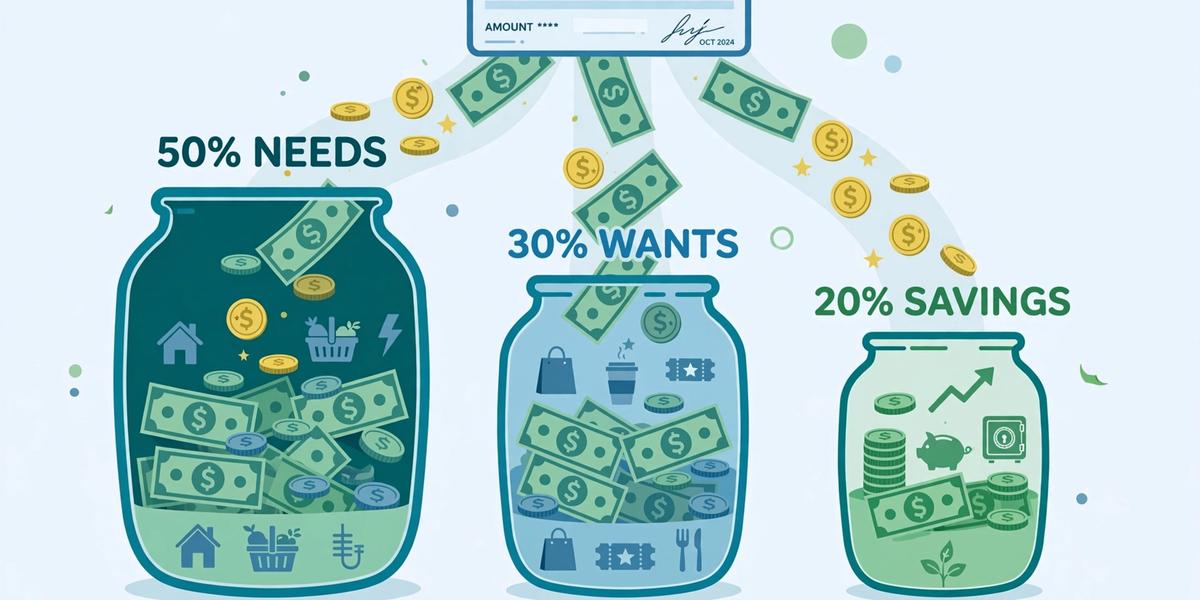
Short answer: The 50/30/20 rule splits your take-home pay into three buckets — 50% for needs, 30% for wants, and 20% for savings and debt payoff. On a $4,000 monthly paycheck that's $2,000 / $1,200 / $800. It's a starting framework, not a law: adjust the percentages to your city and income, but protect the savings bucket first.
Most budgets fail because they're complicated. Fifty categories, three apps, a spreadsheet you abandon by February. The 50/30/20 rule survives because it has exactly three numbers to remember — and those three numbers answer the only question that matters: where did my paycheck go?
What the 50/30/20 rule is
Popularized by Senator Elizabeth Warren in her 2005 book All Your Worth, the rule divides your after-tax (take-home) income like this:
| Bucket | Share | Covers |
|---|---|---|
| Needs | 50% | Rent, groceries, utilities, transport, insurance, minimum debt payments |
| Wants | 30% | Dining out, streaming, hobbies, shopping, travel |
| Savings | 20% | Emergency fund, investments, extra debt payoff |
That's the whole system. Three buckets, one paycheck.
A real example: $4,000 take-home pay
| Bucket | Math | Amount |
|---|---|---|
| Needs (50%) | $4,000 × 0.50 | $2,000 |
| Wants (30%) | $4,000 × 0.30 | $1,200 |
| Savings (20%) | $4,000 × 0.20 | $800 |
The three amounts always add back to your full paycheck, because the buckets are a partition of one number — not three separate calculations.
What counts as a "need" vs a "want"?
This is where most people get stuck, so be brutally honest:
Needs (the 50%) — you'd face serious consequences for skipping these:
- Rent or mortgage, utilities, groceries
- Transport to work, car insurance
- Health insurance, medications
- Minimum payments on debt
- Childcare you need in order to work
Wants (the 30%) — life is better with them, but you'd survive:
- Restaurants, takeout, coffee shops
- Streaming subscriptions, gaming
- Clothes beyond basics, gadgets
- Vacations, hobbies, gym membership
The gray zone: a phone plan is a need; the newest iPhone every year is a want. Internet is a need for most workers; the fastest tier usually isn't. When in doubt, ask: could I still live and work without this?
The #1 mistake people make
Treating savings as whatever is left over at month's end. It never survives — something always eats it.
The rule only works if the 20% moves first. On payday, transfer your savings amount out before you spend anything — treat it like a bill you owe yourself. A savings bucket filled last shrinks to nothing; a savings bucket filled first is the whole point.
When 50/30/20 doesn't fit (and what to do instead)
The rule is a starting framework, not a law. Two common situations break it:
You live in an expensive city. If rent alone eats 45% of your paycheck, 50% for all needs is fantasy. Adjust the split — 60/20/20 or even 70/20/10 — but keep one principle: cut wants before touching savings. A realistic 60/25/15 you actually follow beats a perfect 50/30/20 you abandon.
Your income is very low. If needs genuinely consume 90%+, no percentage trick creates savings out of thin air. The honest priority then is increasing income or cutting fixed costs (roommates, cheaper transport) until there's room to save — even 5% to start.
The pattern as income grows: fixed needs usually don't rise as fast as raises do. The smart move is letting the savings bucket absorb raises instead of lifestyle inflation — that's how 50/30/20 quietly becomes 40/25/35.
Popular variations
- 75/15/10 — for high-cost areas: 75% needs, 15% wants, 10% savings.
- 60/20/20 — a common realistic split when rent is high.
- 40/40/20 — for high earners who want more lifestyle spending while still saving a fifth.
- Pay-yourself-first (80/20) — skip the needs/wants split entirely; save 20% off the top and spend the rest freely. Best for people who hate categorizing.
How to start in 3 steps
- Find your take-home number. Last month's actual deposited pay — not your salary, not gross. After tax, after deductions.
- Multiply by 0.5, 0.3, 0.2. Write the three numbers on paper or a notes app. That's your budget.
- Automate the 20%. Set an automatic transfer for the savings amount on payday. Done — you've implemented the entire system.
Track for one month: at month's end, compare what you actually spent in each bucket against the targets. Adjust the percentages once, then stop tweaking and let it run.
Frequently asked questions
Is the 50/30/20 rule a good idea? For most people, yes — it's the simplest budget that actually gets followed. Its strength is simplicity, not precision. If you need precision (aggressive debt payoff, irregular income), graduate to zero-based budgeting later.
Does the 20% savings include my 401(k)? Two valid approaches: (A) calculate the split after your 401(k) contribution is deducted — then the 20% is extra savings on top; (B) calculate on pay before the 401(k) and count the 401(k) inside the 20%. Pick one and stay consistent.
Should student loan minimums go in needs or savings? Minimum payments are needs (the 50%). Anything you pay above the minimum counts as savings/debt payoff (the 20%). Same logic for credit cards and car loans.
Do taxes count in the 50%? No. The rule runs on net income — federal tax, FICA, and state tax are already gone before the math starts.
What if I can only save 10%? 10% beats 0% every time. Save what you can now, then raise it by 1% each time your income grows. The habit matters more than the starting percentage.
Is the 50/30/20 rule outdated in 2026? The exact percentages are a starting point, not scripture — in expensive cities they need adjusting. But the core principle (explicitly bucketing needs, wants, and savings instead of hoping money is left over) is as relevant as ever.
Budgeting for something big?
The same bucket thinking works for one-time big expenses. Planning a wedding? Our free wedding budget calculator splits your total budget across every category — venue, catering, photo, and more — with live warnings when a category runs over. Same philosophy: give every dollar a job before you spend it.